
Short-Term Rental Management: The Complete Operator's Guide
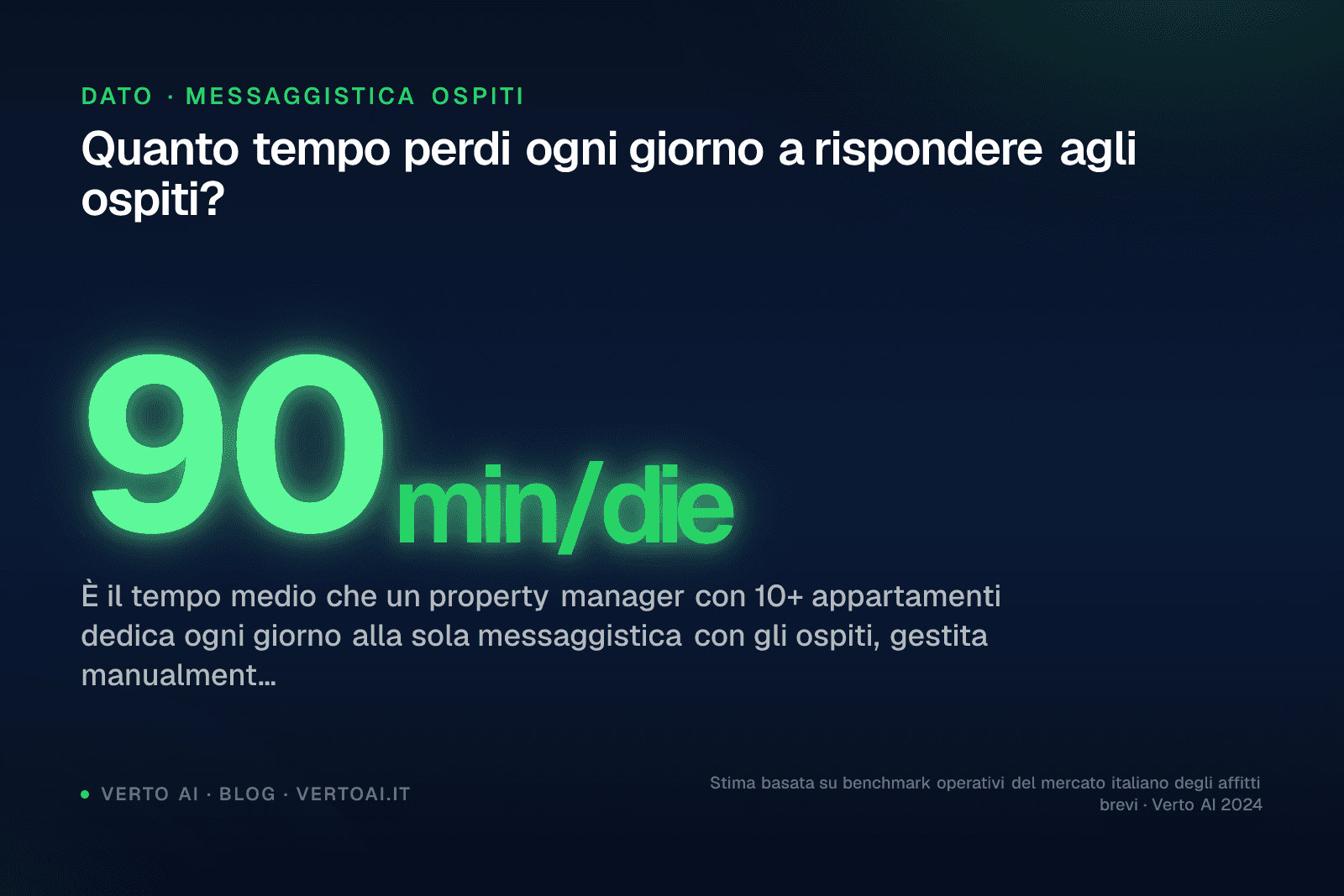
A single short-term rental absorbs 5–7 hours of work per week: roughly 60% of that time goes into guest communication, the rest into cleaning coordination, calendars, pricing and compliance. This guide covers the six areas of the job — compliance, distribution, guests, operations, pricing, tax — and compares the real cost of self-managing, hiring a property manager, and running a software stack.
Capitolo 01 / 11
01 — The map: six areas of short-term rental management
Short-term rentals stopped being a weekend side hustle somewhere around 2024. Registration schemes, night caps and platform-level tax reporting turned hosting into an operation with real processes behind it. Whether you run two apartments or fifty, the work always splits into the same six areas:
| # | Area | What it covers | Covered in |
|---|---|---|---|
| 1 | Compliance | Licences, registration numbers, guest reporting, night caps | Section 02 |
| 2 | Distribution | Listings, calendars, channel manager, PMS | Section 03 |
| 3 | Guest communication | Messages, questions, emergencies, reviews | Section 04 |
| 4 | Operations | Cleaning, turnover, check-in, maintenance | Section 05 |
| 5 | Pricing | Dynamic rates, minimum stays, occupancy | Section 06 |
| 6 | Tax | Income reporting, tourist tax, VAT/sales tax | Section 07 |
Each section below covers the essentials of one area. Sections 08 and 09 hold the part most operators actually search for: what the three management models cost side by side, and where the hours physically go.
All figures are in EUR. Local rates vary, but the ratios between them hold up in most Western markets.
Capitolo 02 / 11
02 — Compliance: licences, guest reporting, night caps
Compliance is the only area where a mistake costs money rather than time, which is why it belongs first. The specifics differ by country and increasingly by city, but the categories are consistent:
- Registration or licence number. New York's Local Law 18, Barcelona's HUT licence, Lisbon's Alojamento Local registration, Italy's CIN, Amsterdam's rental permit — most impose a number that must appear in every listing. Platforms now delist non-compliant properties automatically, and fines in the EU commonly run into four figures per unit.
- Guest identity reporting. Spain, Italy, Portugal and Greece require guest identity data to be filed with the police or a national database, typically within 24 hours of arrival.
- Night caps and use limits. London's 90-night rule, Paris's 120-day cap on primary residences, Amsterdam's 30-night limit. Exceeding them is tracked by the platforms themselves.
- Tourist tax. In most European cities the operator collects it from the guest, remits it to the municipality and files a periodic return.
In short — Compliance
- The licence number must be live in the listing before the first booking, not after
- Guest reporting deadlines are usually 24 hours, sometimes shorter for one-night stays
- Night caps are enforced by the platforms, not just by the city
- This is the only area where the downside is a fine rather than lost time
The usual failure is not ignorance of the rules — it is running them by hand across 10–20 units, photographing documents at check-in and typing them up in the evening. Moving document collection to WhatsApp before arrival turns the check-in desk job into a two-minute verification.
Capitolo 03 / 11
03 — Distribution: channels, channel manager and PMS
Every extra channel — Airbnb, Booking.com, Vrbo, your own direct site — raises occupancy and multiplies operational risk. Double bookings almost never come from bad luck; they come from calendars that are not synced. Past three to five units you need two tools:
- Channel manager: pushes availability and rates to every portal in near real time. Standalone or bundled inside a PMS, it costs €10–30 per unit per month. The selection criteria are in the channel manager guide.
- PMS (property management system): centralises reservations, guest records, payments and automations. The platforms most operators land on — Smoobu, Lodgify, Hostaway, Beds24, Guesty — run €20–60 per unit per month.
The decision that matters is not which brand, it is which system holds the truth. Whatever you pick becomes the data source for messaging, cleaning schedules and pricing, so migrating later is expensive. Pick the one your channels support natively and your team will actually open.
In short — Distribution
- Two or more channels without sync means double bookings eventually, not maybe
- Channel manager €10–30/unit/month; full PMS €20–60/unit/month
- The PMS is the data source for everything downstream — choose it as an infrastructure decision
Percorso
Livelli di automazione nella gestione affitti brevi
Gestione manuale
€0 strumentiTutti i messaggi scritti a mano, nessuna integrazione tra strumenti, reperibilità personale 24/7
Template + PMS
€20-40/apt/meseMessaggi standard automatizzati via email o SMS, calendario centralizzato, ma nessuna gestione domande fuori schema
Automazione rule-based
€15-30/apt/meseTrigger automatici per eventi prenotazione, ma risposta limitata a scenari predefiniti, nessun supporto multilingua avanzato
Verto AI — Concierge WhatsApp
€24,90/apt/meseAI conversazionale su WhatsApp, 25+ lingue, integrazione PMS live, gestione domande fuori schema, copertura 24/7
Capitolo 04 / 11
04 — Guest communication: the bottleneck
Every booking generates 8–12 messages, from the first inquiry to the review request. Run 15 apartments at 65% occupancy and that is 400–500 messages a month, a large share of them outside working hours: the 9 pm to midnight window concentrates the urgent ones — access, Wi-Fi, heating. Add international guests, who in most European cities are 50–70% of arrivals, and you are answering in English, German, French and Spanish.
Messages fall into two families with entirely different solutions:
- Standard and predictable — confirmation, check-in instructions, check-out reminder, review request. These automate cleanly with IF/THEN rules and cost nothing but setup time.
- Off-script — "can I bring my dog?", "the heating won't start", "is there a pharmacy open now?". Rules break here. You need either a human on call, which costs €800–1,500 a month for a part-time night operator, or conversational AI wired into the booking data.
The channel matters as much as the content. Guests do not read email during a stay; WhatsApp is opened by over 90% of recipients within minutes. That is why an AI concierge like Verto runs on WhatsApp: 24/7 in 25+ languages, understanding text, photos and voice notes, and across 12,000+ measured conversations it resolves 85% on its own, escalating only the exceptions. See how it works.
In short — Communication
- 8–12 messages per booking; urgency peaks between 9 pm and midnight
- Standard messages → rule-based automation. Off-script questions → AI or a human on call
- WhatsApp beats email and in-app inboxes on read speed by an order of magnitude
Capitolo 05 / 11
05 — Operations: cleaning, turnover and check-in
Operations is the most physical area and the least compressible. Two processes dominate it.
Turnover cleaning. A full changeover costs €40–90 per visit, or €15–25 per hour, and has to be coordinated against actual check-out and check-in times. The hard part is not the cleaning, it is knowing when to clean. Photo checklists and an automatic notification to the cleaning team on every new booking eliminate most of the errors that produce a bad first impression.
Check-in. Self check-in needs two things: an unattended access method (a lockbox at €25–60, or a smart lock at €150–350 one-off) and instructions delivered at the right moment on the right channel. A code emailed the day before is not delivery — it is hope. Sending it on WhatsApp two to three hours before arrival, with a photo of the street door and a short video of the lock, collapses the volume of "I can't get in" calls. Full setup in the self check-in guide.
In short — Operations
- Turnover €40–90 per changeover; coordination is worth more than the cleaning itself
- Self check-in: one-off hardware plus automated instructions on WhatsApp
- Every booking should notify the cleaning team by itself, with no manual step
Capitolo 06 / 11
06 — Pricing: the most neglected revenue lever
A static rate card loses money twice: too cheap during events and peak weekends, too expensive in the midweek gaps that then never fill. Dynamic pricing — done manually with a weekly review, or through tools like PriceLabs, Wheelhouse or Beyond at roughly €20–40 per unit per month or 1% of revenue — is typically worth +10–30% RevPAR at the same occupancy.
Three rules get you most of the way even without a tool: differentiate weekend from midweek, flex the minimum stay to fill orphan days, and review the next 30 days at least once a week. A comparison of the tools sits in pricing tools for Airbnb hosts.
In short — Pricing
- A static rate card costs 10–30% of achievable revenue
- Tools run ~€20–40/unit/month and usually repay themselves in the first peak month
- Bare minimum: weekend ≠ midweek, plus a weekly review of the 30-day window
Capitolo 07 / 11
07 — Tax: income, tourist tax, VAT
Tax treatment is the one area where local rules diverge too much for a generic answer, but three obligations show up almost everywhere.
Rental income is taxable wherever the property sits, regardless of where you live. Since DAC7 in the EU and 1099-K reporting in the US, platforms report host earnings directly to tax authorities, so the gap between declared and platform-reported income is now visible by default. Several countries also apply a flat rate to short-term rental income instead of ordinary bands.
Tourist tax is collected from the guest and remitted by the operator, with rates and returns set city by city. Some platforms collect it automatically in some markets and not in others — verify per listing, because the liability stays with you either way.
VAT or sales tax usually kicks in once the activity is deemed commercial: many jurisdictions trigger this above a certain number of properties or when hotel-like services (breakfast, daily cleaning) are provided.
In short — Tax
- Platforms now report earnings to tax authorities automatically
- Tourist tax collection and filing normally sit with the operator, not the platform
- Crossing into "commercial activity" changes the VAT position — check the threshold in your market
Capitolo 08 / 11
08 — Self-managing, property manager or software stack
The three models compared, on a typical apartment producing €1,800 per month gross:
| Criterion | Self-managed (manual) | Property manager | Self-managed + software stack |
|---|---|---|---|
| Direct cost | €0 | 15–25% of gross | €60–110/unit/month (PMS + pricing + AI concierge) |
| On €1,800/month gross | €0 | €270–450 | €70–110 |
| Your time | 5–7 h/week per unit | 0.5–1 h/week total | 1–2 h/week per unit |
| Overnight coverage | you, always on call | usually included | AI, 24/7 |
| Control over guests and revenue | full | delegated | full |
| Makes sense when | 1–2 units, plenty of free time | you live far away or want out of operations | 3+ units run as a business |
The choice is arithmetic, not ideology. If your time is worth more than €15–20 an hour, fully manual management above two or three units is the most expensive of the three options — it just bills you in evenings instead of euros. A property manager buys your time at the highest price on the board: €3,200–5,400 a year for this single apartment. The software stack costs about a quarter of that and leaves you holding the guest relationship. If you are weighing the delegation route, what a property manager actually does breaks down what the commission buys.
Capitolo 09 / 11
09 — Where the hours actually go
Time spent by an operator with 15 apartments at 65% occupancy — about 45 bookings a month — measured by activity:
| Activity | Hours/month | Automatable? |
|---|---|---|
| Standard messages (confirmations, check-in, check-out) | 8 | Yes, near 100% (rules/templates) |
| Answering guest questions | 12 | Yes, 80–85% (conversational AI) |
| Cleaning and maintenance coordination | 6 | Partly (automatic team notifications) |
| Calendars and pricing | 4 | Largely (channel manager + pricing tool) |
| Compliance (guest reporting, tourist tax, returns) | 3 | Partly (documents collected pre-arrival) |
| Total | 33 | ~70–80% of the total |
Dato
Distribuzione tempo operativo mensile (15 appartamenti)
Peak
12ore/mese
Risposte ospiti
Range
4 – 12
ore/mese
The heaviest line — 20 hours out of 33 — is communication, and it is also the one that automates best. Standard messages go to PMS templates. Off-script questions need an AI layer: with Verto AI (from €24.90 per apartment per month, 30-minute setup, native integrations with Smoobu, Lodgify, Beds24, Hospitable, Hostaway, Guesty, OwnerRez and SmartPMS), those 20 hours drop to three or four hours of supervision. Across 15 apartments the bill is €373.50 a month against €400–500 of recovered time valued at €25 an hour — before counting overnight coverage, which alone would cost €800–1,500 a month in human staffing. The plans are here, and there is no lock-in: cancel whenever you want.
There is a second, measurable effect. Communication-related complaints — slow replies, wrong information — account for around 40% of low ratings on Airbnb, and sliding from 4.8 to 4.6 stars cuts listing visibility by 15–20%. Response speed is a distribution lever, not just a service one.
"The problem is never the price of the tool. It's the cost of not using it."
— Francesco Noli, founder of Verto AI
Capitolo 10 / 11
10 — Where to start
You do not have to automate everything at once. The order that works:
- Get compliance clean — licence number live in the listing, guest reporting set up, tourist tax filings scheduled. It is the only area where the penalty is a fine.
- Adopt a PMS with a channel manager if you have 3+ units or 2+ channels. It kills double bookings and becomes the data source for everything else.
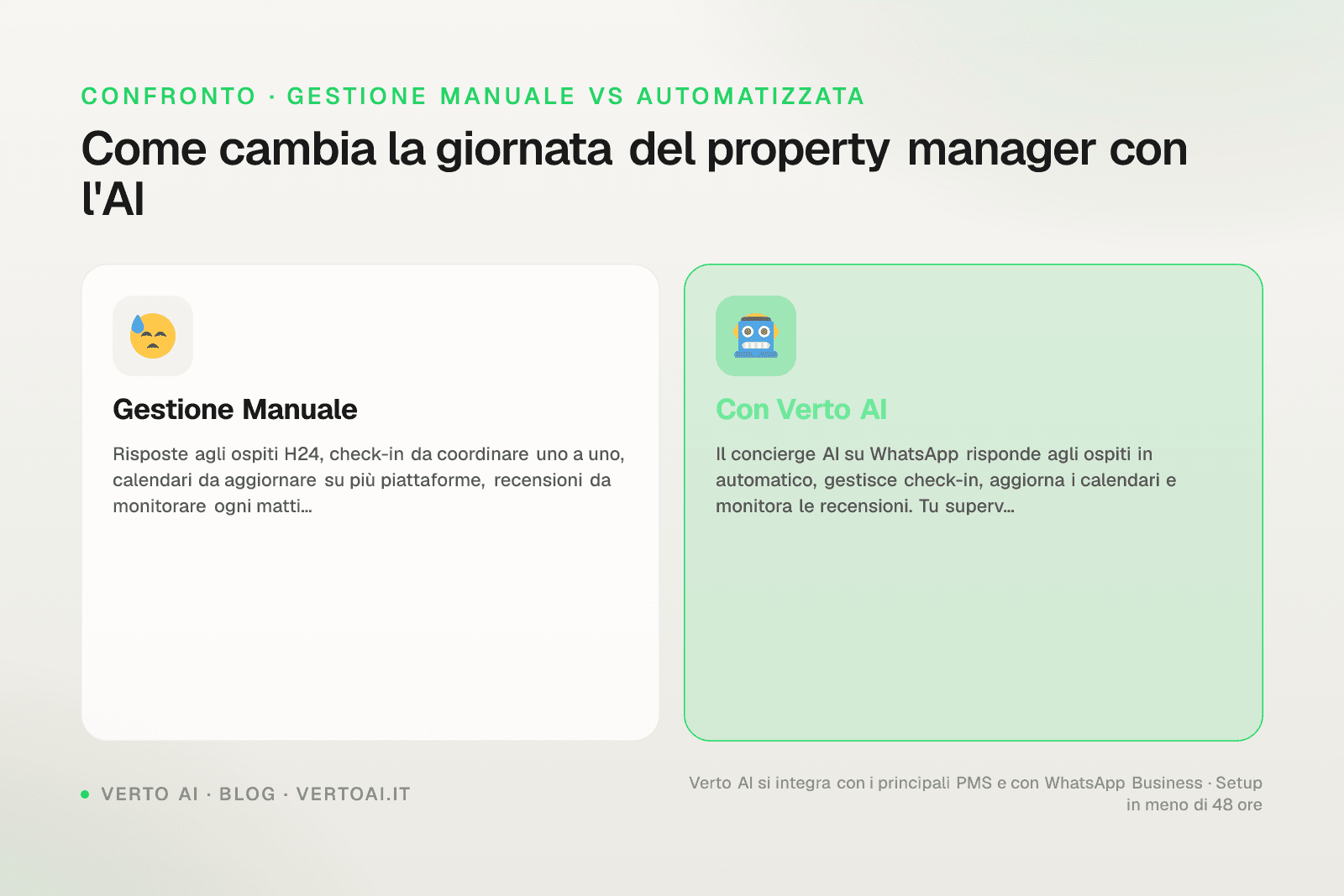
- Automate the standard messages, then add an AI layer on WhatsApp for off-script questions and overnight coverage. This is where the bulk of the hours come back. Step-by-step: how to automate messages to Airbnb guests.
- Turn on dynamic pricing and measure — response time, messages per booking, average rating. Review the whole system quarterly.
If you run anywhere from 1 to 50 apartments and want to see how the numbers land against your own portfolio, compare Verto with the alternatives before you commit to anything.
Capitolo 11 / 11
City and Country Guides
Everything above applies wherever you operate. What changes locally is the paperwork — registration codes, night caps, tourist tax, police reporting — and it is not derivable from national law.
- Short-term rental management in Milan — Italy's largest market, strong business and trade-fair demand.
- Italy for non-resident owners — managing an Italian property from abroad.
- Portugal and the Algarve — AL registration after Decree-Law 76/2024.
- UK Airbnb hosts — four nations, four different rulebooks.
- Boston and New York City — the two strictest US regimes.
On fees specifically, the agency-versus-stack comparison is in vacation rental management.
Keep going
See Verto at work
Want to see Verto on a real conversation?
Self-service setup in 30 minutes, no lock-in. Plugs into the channel manager you already use.